Bellevue’s lost interurban: photos show the Lake Shore Electric cars that stopped downtown until 1938
Archive photos held by the Columbus Metropolitan Library show Lake Shore Electric cars picking up passengers in downtown Bellevue, crossing the Nickel Plate and making their last run in 1938.

Before most roads around Bellevue were paved and before most families here owned a car, the fastest way to Norwalk, Fremont or Cleveland for a lot of people here was an electric interurban car that stopped downtown. The Lake Shore Electric Railway carried passengers through Bellevue for more than three decades, and a set of photographs held by the Columbus Metropolitan Library shows what that looked like.
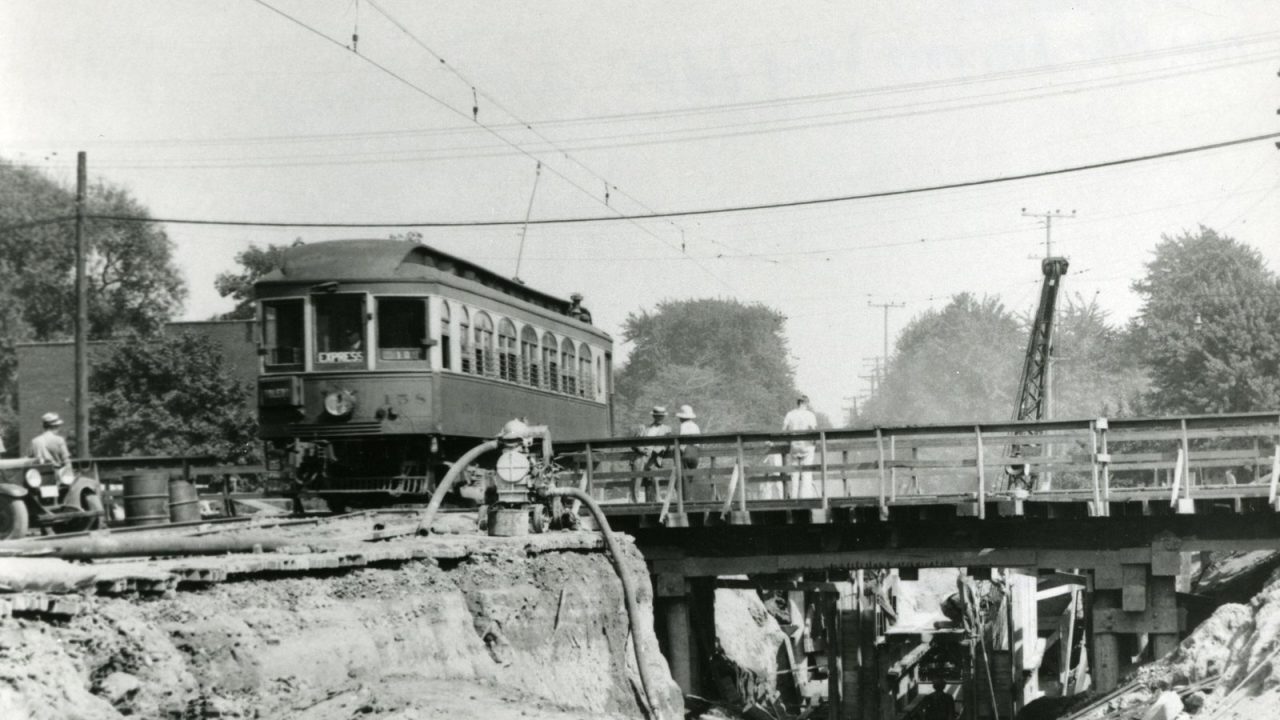
One picture shows car No. 151 picking up passengers in downtown Bellevue, with men in overcoats crossing in front of it and a boxy sedan parked behind. Another shows car No. 158 crossing the Nickel Plate Road at grade while crews dig an underpass beside it, a project the library’s description says was meant to move the interurban beneath the steam railroad’s tracks and end a dangerous crossing. A third shows car No. 20 in Bellevue on the line’s final day of service.
How the line came together
According to the library’s archive notes, the Lake Shore Electric began operating in August 1901 through the merger of four smaller companies: the Lorain & Cleveland Railway, the Sandusky & Interurban, the Toledo, Fremont & Norwalk, and the Sandusky, Milan & Norwalk. It later added the Lorain Street Railway and the Avon Beach & Southern.
The main line hugged the Lake Erie shore between Cleveland and Toledo. Bellevue sat on the southern route. Trains running between the two cities could split into separate cars, with some going by way of Huron, Sandusky and Castalia and others through Norwalk, Monroeville, Bellevue and Clyde before the cars were rejoined at Fremont or at Ceylon Junction east of Huron. In a town already built around steam railroads, that meant one more set of tracks, and frequent cars, running through the middle of things.
Paved roads and the Depression
The library’s notes say passenger business started slipping in the late 1920s as roads improved and cars got cheaper, and the Depression made it worse. Around 1930 the company built up a freight business with the Cincinnati & Lake Erie, another interurban, which connected at Toledo. Between them, the two lines could move freight overnight across roughly 300 miles from Cincinnati to Cleveland.
It wasn’t enough. The railway went into bankruptcy, a strike by freight employees in 1937 shut down freight service, and in 1938 the company abandoned passenger service too. The loss of the Lake Shore connection helped push the Cincinnati & Lake Erie out of business in 1939.
Bellevue kept its steam railroads, and Norfolk Southern’s yard remains the city’s biggest link to the rail network. Our history of how Bellevue became a railroad town covers the lines that came before and after the interurban. We wrote about what the Union Pacific-Norfolk Southern merger review could mean for the yard this week, and about rail safety in a rail town earlier this year.
Where to see more
The three Bellevue photographs are part of a larger Lake Shore Electric collection the Columbus Metropolitan Library contributed to Wikimedia Commons, where they can be viewed and downloaded at full size. Closer to home, the Mad River & NKP Railroad Museum keeps the city’s rail history on display, so check its hours before you go. More Farm & Rail coverage is on our Farm & Rail page.